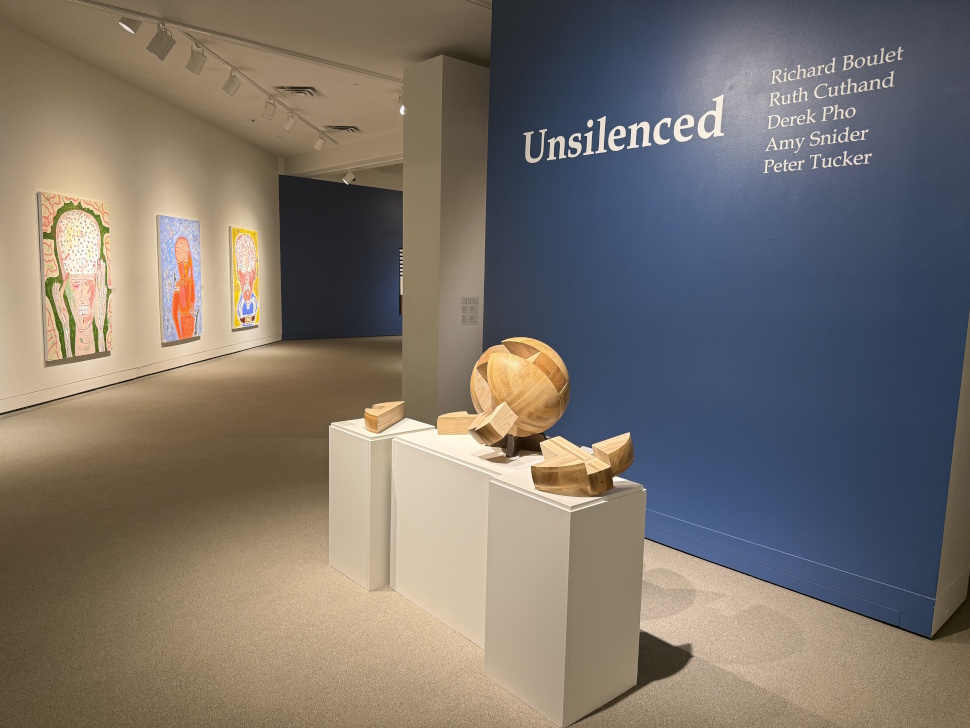
The Moose Jaw Museum and Art Gallery (MJMAG) recently launched Unsilenced, a new exhibition that features the work of five artists exploring mental health, identity, and healing through diverse media.
On display unitl May 3, the exhibition including sculptures, beadwork, fibre art, painting, and a ceramic installation, each offering a unique perspective on personal and community experiences with mental health.
Varied artistic responses to mental health
Unsilenced brings together four Saskatchewan-based artists and one from Alberta:
- Richard Boulet, whose layered fibre pieces explore his experiences living with schizophrenia.
- Ruth Cuthand, a Saskatoon-based Indigenous artist whose beaded “brain scan” works address mental health and intergenerational trauma.
- Derek Pho, whose paintings reflect his lifelong relationship with Obsessive-Compulsive Disorder.
- Amy Snider, whose interactive ceramic installation examines climate anxiety.
- Peter Tucker, a Moose Jaw artist whose sculptural work addresses identity and belonging.
MJMAG director/curator Jennifer McRorie said the show is designed to offer multiple points of entry for visitors.
“Hopefully people will find something that would interest them,” McRorie said.
Inside the artwork
Pho’s paintings, which date back to the late 1990s, use meticulous, continuous line work to depict the relentless fixations of Obsessive-Compulsive Disorder, a process the artist has described as meditative.
“People might want to come up and have a close look at his surfaces because he’s included what he calls mazing,” McRorie said.
“It’s these intricate patterns of lines where he tries to not have the lines touch and it’s almost like a one-line drawing, continuous line drawing.”
Cuthand’s beadwork transforms imagery inspired y neuroscience into glowing representations of conditions such as anxiety and depression — crafted with glow-in-the-dark beads and lit under black light.
Boulet’s fibre collages weave together embroidery, knitting and quilting, and incorporate text that reflects memory and lived experience.
Snider’s installation invites visitors into a room strewn with ceramic pots and a wall of text.
Viewers are encouraged to choose who they walk through the space as a metaphor for personal impact on the environment.
“She wants you to choose whether you are going to walk gingerly and be mindful of your own footprint in the environment or if you’re going to crush the pots as you walk through the space,” McRorie said.
Tucker’s sculptural pieces reflect his journey as a biracial adoptee seeking identity and grounding, paired with masterful woodworking.
A space for reflection
To provide support for the emotional responses that the exhibition could trigger, the MJMAG created a “reflection room.”
In this space, visitors can sit, read more about the artists, or respond to the works.
McRorie also highlighted an element of community action tied to the exhibition. Snider has founded a grassroots group, Eco Sask, focused on addressing climate anxiety through engagement and activism.
link
About the Author