


Region is dealing with ‘very, very complex social conditions and they are very interconnected,’ city council hears
Housing and homelessness, mental health and addiction, and getting help remain onerous for many people across the region, a consultant recently told Orillia city council.
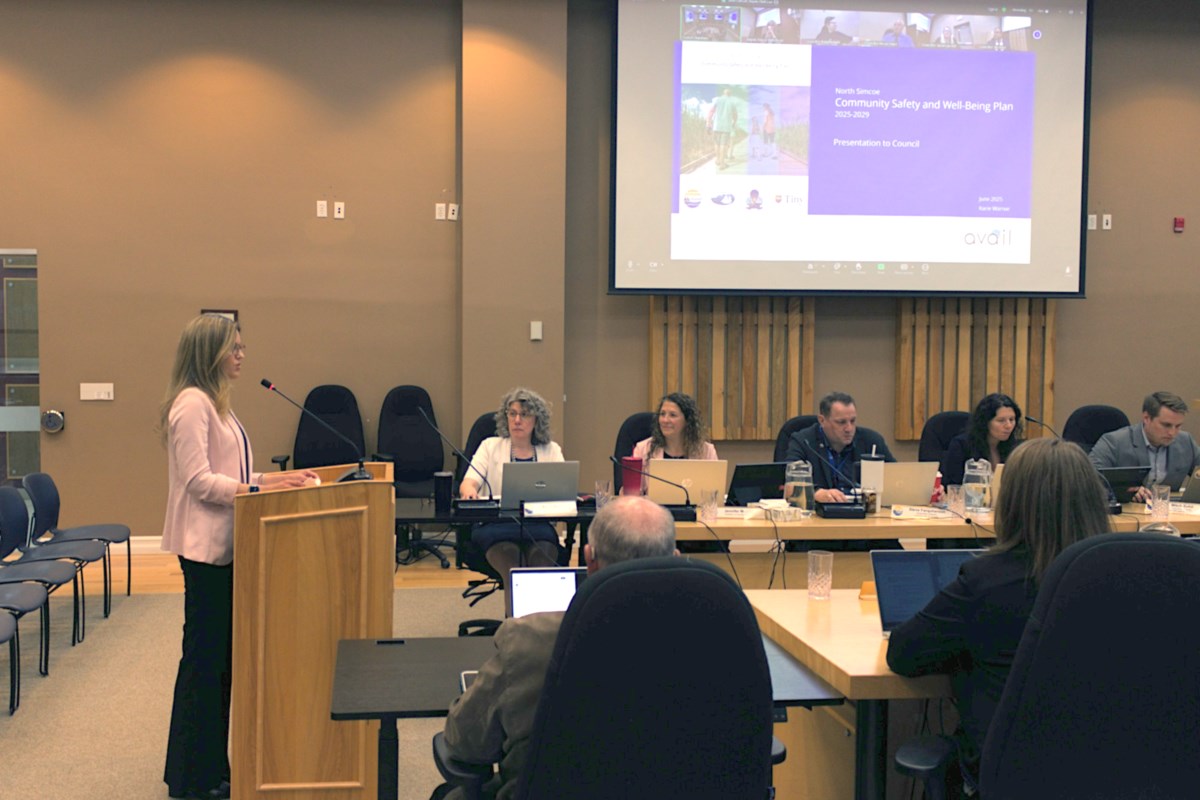
Karie Warnar, of Avail Consulting, presented council with the 2025-29 Couchiching Community Safety and Well-Being Plan at the recent council meeting through a virtual deputation.
“When you look back at your original plan, the areas of risk — housing, homelessness, mental health and addiction, and access to services and supports — we know that they have not improved,” she said.
Warnar said the community is dealing with “very, very complex social conditions and they are very interconnected,” so the response must be on numerous levels as well.
This is the second four-year plan for the Couchiching region, which is made up of Orillia and the townships of Oro-Medonte, Ramara and Severn. It came out of provincial legislation — the Safer Ontario Act, 2018 — requiring all municipalities to develop a Community Safety and Well-Being Plan. The first plan was from 2021 to 2025. There are six such plans across Simcoe County.
“Community safety and well-being is the ideal state of a sustainable community where everyone is safe, has a sense of belonging, opportunities to participate, and where individuals and families can meet their needs for education, health care, food, housing, income, and social and cultural expression,” reads the County of Simcoe website.
The key strategies are around housing/homelessness, mental health and addiction, access to services and support, and data collection and analysis.
Locally, Warnar gathered information through online surveys that went out to residents and service providers. That was followed up with meetings with service providers locally and across the county.
While it is the municipality’s obligation to develop the plan, “these plans really rely on the community partners and the community around us,” she said. Local Ontario Health Teams, mental health and addiction clinics, and poverty reduction groups are the community partners, in addition to police and the hospital.
The housing strategy focuses on the referral pathways to prevention of homelessness, she said.
The mental health and addiction strategy focuses on people ages 12 to 25.
“Service providers have identified that is the target demographic that really needs attention because we know that when you approach 18, you move from being served as a child into adult programs, and sometimes there is a little hiccup,” Warnar said, adding local providers that work with youth are working to bridge the gap and make sure youth and their families are supported.
Providing local mental health services in a timely manner is key to the overall plan.
“We know that there’s already really good work happening in your community. You have a very, very progressive community,” she said.
One of the improvements she’d like to see is not only people getting referrals to helping services, but also having the ability of “self-booking.”
“How do they (look) into things themselves?” she asked.
Lastly, data is collected across the county with the purpose of identifying emerging threats and taking action quickly to better people’s health.
While improvement wasn’t seen in certain areas, changes to the new plan will provide better service to people, a better data-collection system and improved communication to the community as a whole, Warnar said.
Better service to people means creating numerous places for people to get help, as opposed to a one-way system that doesn’t reach everyone in need of assistance. Warnar said there is more a co-ordinated process developing to address homelessness, and she’s like to see the same system be adopted for mental health.
“I think that’s where you are going to find a real kind of magic or synergy … when systems start talking to each other. Then it’s not incumbent or people trying to figure out all those systems because that’s where we see the points of failure,” she said.
“This plan is leaner than the last plan. Each strategy has a lead agency and partners … It’s going to be that lead agency that tracks and co-ordinates the activities and tracks the progress.”
Better communication is expected with annual plan updates to council.
Council approved the 2025-29 plan.
link