Travelling can be an adventure — but it also comes with its fair share of health risks. Between dry cabin air, time zone changes and exposure to countless germs in airports and on planes, staying healthy while travelling — especially during peak travel periods like Christmas — can feel like a full-time job.
So what can you do to prevent sickness while travelling? We asked Pam Huynh, a flight attendant with more than nine years of experience in the industry, to share her insider tips on how she stays healthy while on the move. In a job where long hours, contact with numerous passengers and recycled cabin air are part of the daily routine, staying well isn’t just a nice-to-have — it’s essential.
So, what does she recommend? From smart hygiene habits to travel-tested wellness routines, Huynh shares eight tips to avoid getting sick while going on a trip. Whether you’re a frequent flier or just heading home for the holidays, these game-changing tips might just change the way you travel.
Pam Huynh has been a flight attendant for several years, so she knows a thing or two about staying healthy while travelling. (Courtesy of Huynh)
How to avoid getting sick while travelling | Expert tips
1. Boost your immune system
“I like taking vitamin C pills before every flight,” says Huynh. “A lot of people like to drink the Emergen-C drinks, but I like the pills. I just pop one before every flight, and I know that I have all my vitamin C and I’m good for the day.”
According to Harvard Health Publishing, vitamin C supports the immune system by protecting cells from free radical damage and enhancing the body’s natural defences.
Other things — including getting adequate sleep, minimizing stress and taking steps to avoid infection (such as washing your hands) — are all ways you can keep your immune system strong.
Huynh also recommends staying up-to-date on any vaccines you may need for travelling: “A lot of people aren’t aware of what shots they need. It doesn’t hurt to research that before you go somewhere. There are high cases of measles right now in so many places, so always making sure that your vaccinations are up-to-date is a really big thing that’s going to help prevent you from getting sick.”
2. Stay hydrated
Staying hydrated is important at any time, but especially when flying. According to the Cleveland Clinic, at high altitudes, the air is almost completely devoid of moisture, which can cause your throat, nose and skin to feel dry.
“Keeping hydrated is such a key thing, because you don’t realize how dehydrated you get being 25,000 feet up in the air,” says Huynh.
She also recommends bringing an empty reusable water bottle with you — that way, you don’t have to rely on beverage service (or buying a marked-up drink at the airport). “I always bring my own water bottle, and I refill it at the airport,” she shares.
Huynh also notes that staying hydrated helps you avoid travel-related breakouts.
“Your skin really does get dry in the air,” she says. “Personally, I get more oily when I get dry, but when I drink a lot of water, it helps to hydrate my skin, and I don’t have as many skin problems.”
She also says it can help ease jet lag symptoms: “If you just stay hydrated throughout the flight, it kind of keeps you level. It helps you to adjust easier when you land.”
3. Disinfect surfaces
When she travels as a passenger, Huynh says she makes sure to wipe down all the surfaces at her seat.
“I get into my seat, I put away all my stuff in the overhead bin and under the seat, and then I grab my wipes, and I wipe down the tray table. If there’s a TV screen, I wipe that down too, and then I wipe down the armrests and the seatbelts. … I find those are the most-frequently touched places, and people touch those without realizing what else they’ve touched,” she says, noting that many people may not wipe down their trays after using them.
“It’s not a thing that people think about. Even with the seatbelt, people get up, sit down, move around and don’t think about that either. It’s hard to sanitize the actual seatbelt, so I’ll just do the buckle, because that’s the biggest point of touch.”
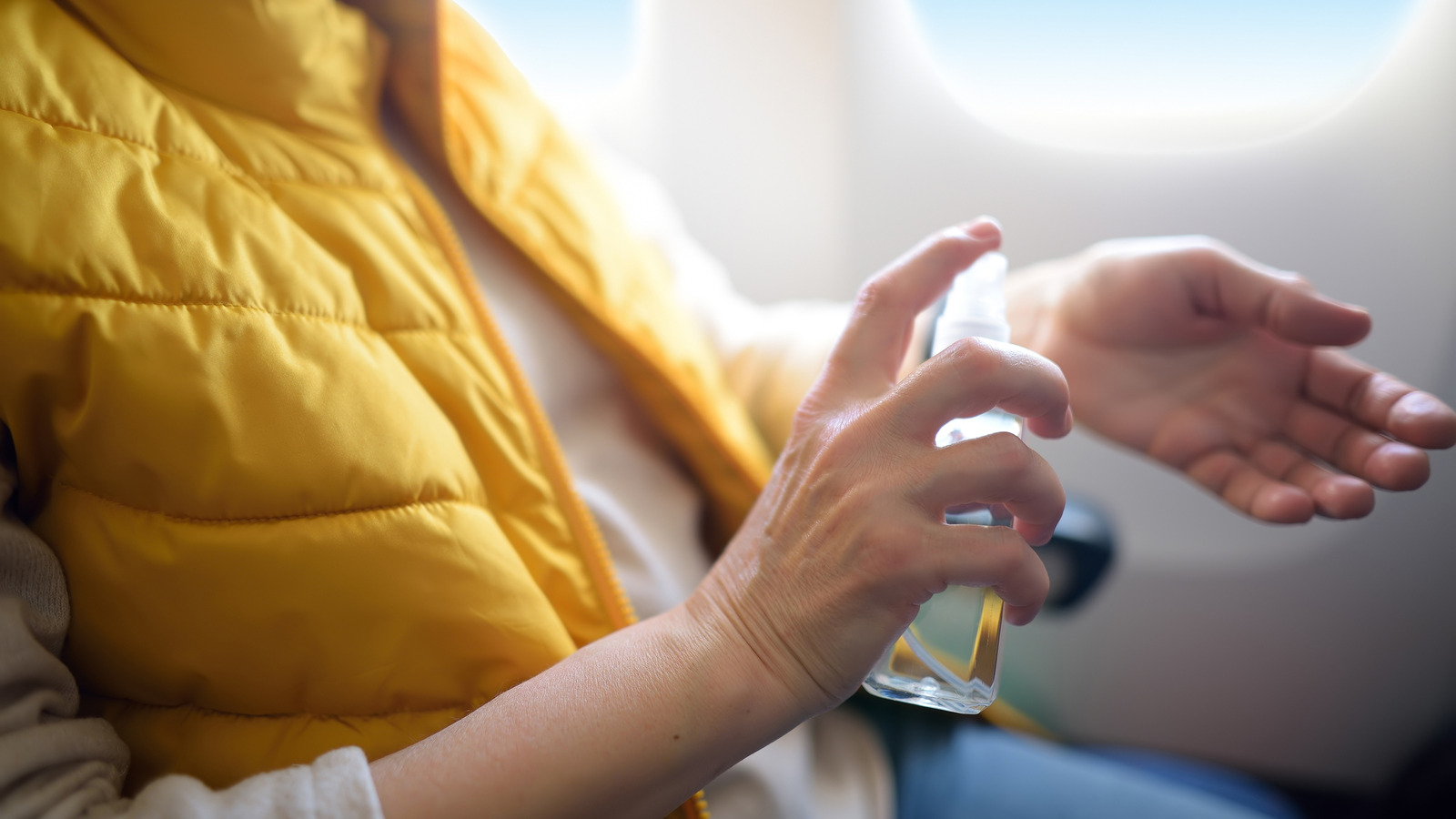
She also recommends carrying a travel-size package of disinfectant wipes for wiping down any high-touch areas, as well as hand sanitizer for your hands.
“Having your own hand sanitizer on the plane and your own disinfectant wipes are really great, just because you can’t always get up to go to the washroom [to wash your hands],” says Huynh.
4. Bring a travel medicine kit
Having a travel health kit with you containing some basic medications — such as anti-motion sickness medication, cold and flu medication and pain relievers — is always a good idea.
Huynh also recommends travelling with a pocket pharmacy, like this one from Saje Natural Wellness.
“It has mint for migraines and headaches, and then it has a few other scents, and I really like using those when I’m starting to get sick or have a headache or a cough or something like that,” she explains, adding she also uses oil of oregano.
“If I felt like I was about to get sick, or was sick, I would take a squeeze of the bottle. And I don’t know if it’s a placebo effect, but I would feel much better.”
She also likes ginger Gravol for combatting nausea, and says it “really helped” when she was feeling nauseous.
5. Choose your seat wisely
Where you sit on the plane can also be important. Some studies suggest that window seats might expose passengers to fewer infectious particles, as passengers in the window seats have less contact with others than those seated in middle or aisle seats. Huynh says she also prefers to take a window seat.
“I stick to myself. I try to get a window seat so that I can stay away from other people,” she says. “I personally don’t love aisle seats, just because I feel like I get bumped by people walking through the cabin … and that’s also extra germs that I don’t want.”
Huynh says she tries to pick a window seat on a plane so that she can stay away from other people. (Getty Images)
Choosing your seat strategically can also help minimize motion sickness.
“For motion sickness, I would say stick towards the front of the plane, if you can,” says Huynh. “I find the back usually feels a bit more turbulence than the front of the plane, so anywhere from the front to middle is usually really good.”
6. Stay warm
Staying warm on a flight isn’t just for comfort. Being cold can also impact how your body fights off infections.
A study by researchers at the Common Cold Centre at Cardiff University in the U.K. found that having cold feet may actually lower your immune response. So it may be a good idea to skip the sandals, even if you’re travelling somewhere hot.
“I’m someone who gets cold easily, so I always have a sweater,” says Huynh. “Sometimes I have a pack of socks in my purse. … Bringing your own sweater, a scarf or a light blanket that fits in your purse or backpack is never a bad idea.”
She adds that it is also possible for the flight crew to adjust the in-cabin temperature: “They can adjust it for the front half [of the plane], the back half. And then, if it’s a really big aircraft, certain areas are possible too.”
7. Consider wearing a mask
Even though masks are no longer required when flying, they can still be a good idea to prevent the spread of illness.
According to the CDC, when worn by a person with an infection, masks can reduce the spread of the virus to others and can protect wearers from breathing in infectious particles from people around them.
“I personally never wore a mask before COVID,” says Huynh. “I found that a lot of travellers in Eastern regions would wear a mask if they were sick, which I thought was such a polite thing to do. I’ve had people before COVID ask me on board for masks, because either they’re sick or they’re near someone that’s sick.”
Now, she says she’ll mask up in certain situations.
“I would wear a mask if I was sick or want to prevent myself from being sick,” she says, noting that you can also use the overhead air vent at your seat to get some added airflow.
8. Try a plane workout
Sitting on an airplane for hours can lead to stiffness, soreness and swelling in your legs and feet, and in some cases, can put you at risk of developing blood clot-related illnesses, such as deep vein thrombosis. Research shows that moving during long flights can help reduce your risk.
“I would say as a general rule of thumb, you want to get up and move at least once every two hours,” says Huynh.
“It’s not always possible, but I’ve seen people do squats in the galley and lunges, and do what they have to do. … Standing up at your seat and taking a stretch once every two hours, that works too.”
According to the U.S. National Blood Clot Alliance, even seated exercises such as ankle circles, knee lifts and overhead stretches can be beneficial.
“Even just stretching your arms goes a long way too, instead of just sitting cramped in and not moving the whole flight,” says Huynh.
Let us know what you think by emailing us or threading us @yahoocanada. Follow us on TikTok, WhatsApp and Instagram.
link
About the Author